



CBG MCT Tincture – 1200mg | Hemp Compliant COA
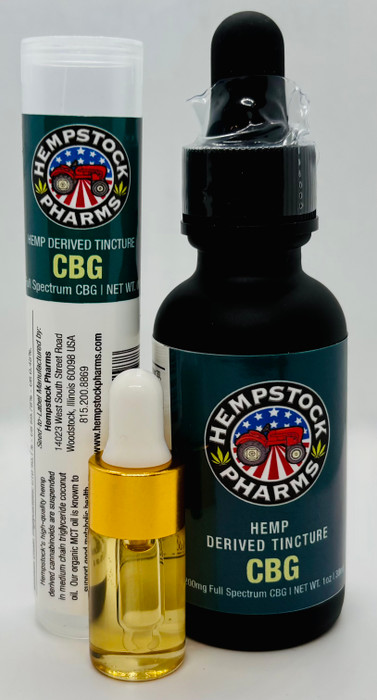
Hempstock Pharms CBG MCT Tincture contains 1200mg of cannabigerol (CBG) isolate blended with a high-quality MCT oil (fractionated refined coconut oil).
Our traditional oil-based tincture combines purified hemp-derived CBG with a simple lipid-based carrier. MCT oil is commonly used in cannabinoid formulations because cannabinoids are naturally lipophilic, meaning they dissolve more readily in fats and oils than in water.
Each 30mL bottle provides approximately 60 servings of 20mg CBG per 0.5mL serving.
What Is CBG?
Cannabigerol (CBG) is a naturally occurring phytocannabinoid found in the Cannabis sativa plant. CBG is classified as a minor cannabinoid because it generally occurs in relatively low concentrations in mature hemp plants.
CBG is sometimes called the "mother cannabinoid" because its acidic precursor, cannabigerolic acid (CBGA), plays a fundamental role in cannabinoid biosynthesis.
During plant development, enzymes convert CBGA into several other cannabinoid acids, including tetrahydrocannabinolic acid (THCA), cannabidiolic acid (CBDA), and cannabichromenic acid (CBCA). These compounds can subsequently undergo decarboxylation to form THC, CBD, and CBC.
CBG is chemically distinct from both CBD and THC and does not produce the characteristic intoxicating effects associated with THC.
Researchers have identified interactions between CBG and several molecular targets, including cannabinoid receptors, alpha-2 adrenergic receptors, serotonin receptors, transient receptor potential channels, and voltage-gated sodium channels.
What Is an MCT-Based Cannabinoid Tincture?
Medium-chain triglyceride (MCT) oil is a refined lipid ingredient commonly obtained from coconut oil.
Because cannabinoids such as CBG have low water solubility, MCT oil provides a carrier medium in which purified cannabinoids can be incorporated and distributed throughout an oil-based formulation.
The formulation has several important physical and chemical characteristics:
-
Lipid-Based Carrier: MCT oil provides an oil medium compatible with the lipophilic properties of CBG.
-
Cannabinoid Dispersion: Purified CBG can be incorporated into a measured volume of carrier oil.
-
Formulation Simplicity: Isolate-based products contain a defined primary cannabinoid without the broad collection of plant constituents typically found in full-spectrum extracts.
-
Concentration Control: The formulation allows cannabinoid content to be expressed in milligrams per milliliter.
-
Lipid Delivery Research: Scientists have studied how different dietary lipids and oil-based delivery systems influence the dissolution, digestion, and absorption of lipophilic compounds.
Unlike our Nano-Hydro formulation, a traditional MCT tincture is oil-based and is not designed to disperse uniformly into water-based beverages.
CBG and Lipid-Based Cannabinoid Formulations
Cannabinoids are lipophilic compounds with limited solubility in aqueous environments.
Researchers have investigated lipid-based delivery systems, including MCT oil and other dietary fats, to understand how formulation composition affects cannabinoid dissolution, digestion, absorption, and systemic exposure.
Bioavailability refers to the proportion of an administered compound that reaches systemic circulation.
Human pharmacokinetic research has examined how dietary fat and oral delivery systems influence blood plasma concentrations of CBG.
These investigations demonstrate that carrier composition and administration conditions can influence cannabinoid pharmacokinetics. Results are formulation-specific and do not establish increased absorption or bioavailability for Hempstock Pharms CBG MCT Tincture.
CBG in Scientific Research
Cannabigerol has attracted increasing scientific attention because of its distinct molecular properties and interactions with several biological signaling systems.
Researchers are investigating CBG through human clinical trials, laboratory experiments, animal models, and molecular pharmacology studies.
Areas of scientific investigation include:
-
Stress, Mood, and Cognitive Research: Human clinical researchers have examined CBG in relation to self-reported stress, anxiety, mood, verbal memory, and cognitive functioning.
-
Sleep Research: Clinical studies have evaluated CBG in relation to subjective sleep quality, sleep duration, and sleep-related measurements. Results have not established a consistent clinical benefit.
-
Cannabinoid and Neurotransmitter Receptors: Researchers have studied CBG interactions with CB1 and CB2 cannabinoid receptors, alpha-2 adrenergic receptors, and serotonin 5-HT1A receptors.
-
Inflammatory Signaling: Laboratory and animal studies have examined CBG's interactions with cellular signaling pathways and molecular markers associated with inflammation.
-
Sensory Neuron Activity: Preclinical studies have investigated CBG interactions with voltage-gated sodium channels involved in electrical signaling in sensory nerve cells.
-
Microbiology Research: Laboratory researchers have investigated CBG interactions with bacterial cell membranes and bacterial growth.
-
Pharmacokinetics: Human researchers have measured CBG blood plasma concentrations over time to study cannabinoid absorption, distribution, and elimination.
These investigations contribute to scientific understanding of CBG's chemistry and pharmacology. Research findings do not establish clinical benefits for Hempstock Pharms CBG MCT Tincture.
Published Scientific Studies – CBG
1. CBG, Stress, Mood, and Memory (2024)
A randomized, double-blind, placebo-controlled crossover study evaluated the acute effects of 20mg CBG in 34 healthy adults.
Researchers examined self-reported anxiety, stress, mood, intoxication, impairment, and verbal memory.
The study reported differences in selected stress, anxiety, and verbal memory measures compared with placebo. Its relatively small sample and short observation period limit the conclusions that can be drawn.
2. CBG, Sleep, and Quality of Life (Published 2025)
A randomized, triple-blind, placebo-controlled clinical study investigated oral CBG in veterans reporting sleep difficulties.
Researchers examined sleep quality, objective sleep-related measurements, quality of life, and PTSD-related questionnaire scores.
The study found no statistically significant improvement in its primary sleep-quality outcome compared with placebo.
3. CBG and Cannabinoid Receptor Pharmacology (2010)
Laboratory researchers investigated CBG activity at alpha-2 adrenergic receptors and serotonin 5-HT1A receptors.
The study examined receptor binding and functional signaling using experimental biological systems.
4. CBG and Inflammatory Signaling (2013)
Researchers investigated CBG in an experimental mouse model of intestinal inflammation.
The study examined tissue characteristics, inflammatory markers, enzyme activity, and cellular signaling pathways.
These findings were obtained in preclinical experimental models rather than human clinical trials.
5. CBG and Sensory Neuron Signaling (2022)
Researchers investigated CBG interactions with voltage-gated sodium channels and electrical activity in sensory neurons.
The study evaluated how CBG influenced sodium conductance and neuronal excitability under experimental conditions.
6. CBG and Nav1.8 Sodium Channels (2025)
Researchers investigated how CBG, CBD, and CBN interact with Nav1.8 sodium channels, molecular components involved in electrical signaling in sensory neurons.
7. CBG and Bacterial Cell Membranes (2020)
Laboratory researchers investigated CBG interactions with bacterial membranes, including experiments involving methicillin-resistant Staphylococcus aureus (MRSA).
The research involved laboratory studies and experimental infection models rather than clinical testing of consumer cannabinoid products.
8. CBG Human Pharmacokinetics (2026)
Researchers examined the pharmacokinetics, pharmacodynamics, and acute safety measurements of orally administered CBG in healthy adults.
The investigation included blood plasma sampling over time and measurements of subjective, cognitive, and physiological responses.
9. Dietary Fat, Oral Delivery Systems, and CBG Pharmacokinetics (2024)
Human researchers investigated how dietary fat and different oral delivery systems influence CBG pharmacokinetics.
The study examined changes in blood cannabinoid concentrations under different administration conditions.
These studies provide scientific context for CBG chemistry, pharmacology, and cannabinoid delivery systems. They do not represent clinical testing of Hempstock Pharms CBG MCT Tincture.
Product Specifications
-
Cannabinoid: Cannabigerol (CBG) isolate
-
CBG Content: 1200mg per bottle
-
Bottle Size: 30mL (1 fl oz)
-
Servings: 60 per bottle
-
CBG per Serving: 20mg
-
Serving Size: 0.5mL
-
CBG Concentration: 40mg/mL
-
Carrier Oil: MCT oil (fractionated refined coconut oil)
-
Formulation Type: Oil-based cannabinoid tincture
-
THC: Subject to finished-product COA verification and applicable hemp regulations
CBG isolate is a refined cannabinoid ingredient designed to provide a concentrated, measurable amount of cannabigerol without the broader range of cannabinoids typically present in full-spectrum hemp extracts.
Our MCT tincture combines purified hemp-derived CBG with a straightforward oil-based formulation commonly used in cannabinoid product manufacturing.
FDA Disclaimer: These statements have not been evaluated by the Food and Drug Administration. This product is not intended to diagnose, treat, cure, or prevent any disease.


